Eastern Connecticut Forest Landowners / Wolf Den Land Trust
A FOREST MANAGEMENT PLAN: A LANDOWNER'S PERSPECTIVE
- By Dennis Hodgin
OVERVIEW
I thought I would add my personal comments and detail some my experiences related to the companion Forest Management Plan (FMP). I am not a forest professional, so my intention is to provide information that could help other landowners make a good decision on determining if a FMP is right for them. I have tried to include a wide range of information that should help to answer the questions we all have when considering a FMP.
My "tree farm" is located is located in the town of Stafford in the northern part of Tolland County in Connecticut. I purchased the land starting with a house and 50 acres "more or less" in 1973, buying additional land from my neighbors in 1977 and 1982. The land is contiguous, now totals about 200 acres, and due to predominately hilly terrain, has limited development potential for its highest use - residential housing. My primary goal is to periodically produce enough income from timber sales to help ease the property tax burden we all face. Having a FMP seemed the most logical way to achieve this objective.
In 1998 I contacted a private forester who had conducted many field events for the Eastern Connecticut Forest Landowners Association (ECFLA) and requested information on a FMP. I probably would not have opted for a plan if there had not been a USDA cost-sharing program (Stewardship Incentive Program or SIP) that would reimburse me for nearly half of the FMP cost. Finding a forester I was comfortable with was key for me, as he not only worked with me to develop a plan that reflected my goals but importantly help get me through the paperwork associated with the various cost sharing programs.
By the spring of 1999 I received USDA approval to reimburse me for up to 75% of the FMP cost. In 1999 the cost of a management plan for my 200 acres was $2,709. The breakdown was 200 acres x $12.50 per acre + $150 Connecticut sales tax + $59 for 2 aerial photos required for the SIP application. The bad news was that the full amount was due to the forester on the completion of the plan (April 1999), but the good news was that I quickly received a $1300 reimbursement in July 1999. I later found out this reimbursement of $1300 was subject to federal and state income tax. Because I run my tree farm as a business, I was able to write off all my out of pocket FMP expenses ($2,709 - $1,300 = $1,409 net FMP expense) for the 1999 tax year.
That covers the FMP itself. Now let's discuss my experience in implementing and living with the plan. I will be referring to some of the specific practices recommended in the FMP, so you will probably need to periodically go back to the detailed FMP itself if the discussion becomes confusing.
Marking of Property Boundaries
The FMP mentions paint-blaze marking with the "appropriate tree marking paint". The traditional paint-blaze method is a two-step approach - first you take a hand axe and make head high scars, both sides, on the tree bark. Later when the scar or "blaze" heals after six months or so, you cover it with a paint splotch using a color unique to ay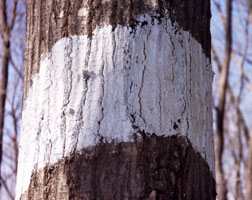 our tree farm and not in conflict with a neighbor's color scheme. I use a light blue color, as it is easy to see year round. My "appropriate tree marking paint" was just a good quality exterior latex paint. I have used it for over 30 years and the paint blazes last at least 10 years before requiring repainting.
Why is the scar/blaze needed? It turns out that the blaze will eventually heal into a vertical line that remains visible on the tree for the life of the tree but will not cause structural damage to the tree if it heals properly. I have found 50 year old blazes in the woods with the blaze scar still visible. Although the paint may be gone, the blazes on a line of trees clearly mark the boundary from previous years. I suggest you keep the paint can label/paint chip with the color code in a "Boundary Marking" file folder for future reference. I also suggest you note the years you marked and blazed the boundaries on a site map. Cleaning your brush on a corner of the paint can label will allow you to color match at a future date in case that color is no longer sold. So much for boundary marking and paint! By the way, I did mark/remark my boundaries in 1999 and 2000. I should also mention that the cost of the paint and brushes used are tax deductible, so keep your receipts!
MU # 1
Management Unit (MU) #1, my largest designated unit has 122 acres (more or less), is mostly wooded land with varying slopes and with a small area of open pasture grassland. Although the 1999 FMP suggests an intermediate tree thinning within 3 years, I have chosen not conduct any forest practice at this time. As the landowner I see the original FMP as a "living document" that can change (slightly) as the landowners goals change. Due to tax considerations, i.e. receiving a large income from a timber sale in one or two tax years, I have decided to defer the recommended practice until I fully retire and my incremental tax situation becomes more favorable. I have checked this change with my forester, and he agrees there is some flexibility on the timing of the recommended forest practice. He may not always be in 100% agreement with my in-process FMP revisions but that is a judgment call on my part. So my take is: - the original FMP is the best practice identified at the time of the writing of the FMP but implementation of the recommendations should be in synch with any changes in the landowner's goals. This does not mean that we should completely abandon the FMP, as we did pay good money for it and I did commit to the recommendations of these good forest practices in 1999.MU # 2
This is a small area (12 acres) with very steep slopes and an adjacent wetland area. It also abuts one neighbor's building lot and house. Because of the steep slope, conventional logging practices are not practical or advisable. The FMP suggest cutting woods roads at the top and bottom of the slope to allow access for harvest. Another alternative is to wait for improvements in harvesting technology to help solve this problem. I have chosen not to do anything at this time. Previously I have built nearly two miles of high quality woods roads on my place. The process is to layout the road path, clear the trees and vegetation and have someone with the correct size bulldozer cut the roads under my day-to-day supervision. I will consider doing the recommended practice the next time I hire a bulldozer to do other work on my place. Base on my past experiences it will take a CAT D5 or D6 / 20 ton size machine to do this task. Bottom line: no action to date. If I do cut some roads as per the FMP recommendation, the cost will be a tax deductible expense so I intend to keep good records on these out of pocket expenses.MU # 3
This 20-acre area is located at the top of a rocky ridge in the very back of the property with a long access to the paved Town road over my interior woods road system. The area was thinned in a 1983/84 and several years later suffered blow down of about 30 large (20" plus DBH) trees. The blow down occurred as the result of Hurricane Gloria and vulnerability due to the exposure from the previous thinning. The soil is very thin and the trees blew down with the roots still intact. The good news was that several years later I salvaged about 6,000 board feet of logs that I skidded with my 30 HP Kubota L2550 farm tractor to an accessible logging landing originally made for the 1983 harvest. A local sawmill bought the logs on my landing so I did manage to reduce my losses. Due to its proximity to MU #2 and its location at the rear of the property, I plan to do the recommended MU #3 harvest concurrently with that of MU #2 .MU #4
MU #4 encompasses 41 acres more or less and is on a west-facing hillside with limited access for a conventional commercial harvest. In plain terms, the best access is near the southernmost tip of its triangular shape. It is a long way to haul logs from the northern extremes of the property for what the 1999 FMP calls as an "intermediate" thinning. The 1999 FMP recommends a subsequent commercial harvest about five years after this intermediate thinning. The main issue was why cause unnecessary disturbance and possible erosion of the forest floor when there is a follow-on forest practice recommendation suggested five years later. The solution determined by the forester was a non-commercial thinning - i.e., girdling around the trunks to kill trees selected for removal (see photo to right.) Because of concern the girdled trees might fall into any area where my neighbor's spring is located and similar concerns for trees falling on the town road and power lines, five acres of the 41 was eliminated from the recommended practice. The forester estimated that it would cost $100/acre for this non-commercial thinning in the remaining 36 acres. He suggested I apply for a $75/acre reimbursement covered under a SIP program. I applied and was approved for SIP reimbursement. The forester handled most of the paperwork and this made the effort manageable for me. So my net cost after SIP reimbursement was 36 acres X $100/acres = $3600 + $216 Ct Sales Tax = $3816 minus the reimbursement of 36 acres X $75/acres = $3816 - $2700 = $1116 . The practice was performed in the year 2000 under the direction of my forester. No herbicide was used to increase the effectiveness of the girdling. It took about two growing seasons to see the die-off of the girdled trees. Five years later, most of the dead trees are still standing, with only a small percentage that have fallen over. Today (2004) you can see that the desired effect of opening the areas around the crowns of the remaining trees was achieved with this practice. It really worked! (Not that I ever doubted my forester!) In another year or so I will need the forester to review the forest condition with a visual examination per the 1999 FMP recommendation. The results should determine if the commercial saw timber harvest recommended by the 1999 FMP should still be planned after another five years (i.e., in about 2010). If that is the recommendation, I will need to clear and maintain the "permanent logging landing" recommended for this area in the 1999 FMP. This something I would do myself as it requires clear cutting a small (one acre?) area just off the Town road.
MU #5
This MU covers only about five or six acres and was covered by a Red Pine plantation probably planted in the late 1940s to early 1950s. A large number of the Red Pines had their main stems snapped during a severe ice storm about ten years ago. The site is well-drained sandy gravelly soil. The remaining undamaged trees were thought to be too small in diameter to be very marketable, so the recommended plan was to clear cut the Red Pine, (and the few Scotch Pine and Larch) leaving all the large White Pines as seed trees. The cutting was not to be done until the "White Pines produced a significant crop of seed-bearing cones." This occurred in 2001. The plan was for this "regeneration harvest" to eventually result in a stand of White Pine and hardwood trees. Since the mission was to remove most of the Red Pine, Scotch Pine and Larch, as outlined in the FMP, I marked the area to be cut with orange ribbons around the boundary and found a local logger who was interested in the Red Pines. Based on the FMP goals my mind set was get as much as wood material removed from the site but leaving White Pine and mature hardwood trees as seed trees. Since this could be done without incurring the cost of having a forester actually mark the trees to be removed, I decided to negotiate a deal with the only logger that expressed any interest. We wrote up a "timber contract" with the following stipulations:- The logger would cut only Red Pine, Scotch Pine and Larch leaving the white Pine and hardwood trees for seed trees.
- They would stay within the area marked (by me) with ribbons and in addition would leave a 25' buffer zone at the State Line on the north and next to my neighbors boundary line on the south.
- The slash and dead trees would be left at a height no greater than three feet high for aesthetics reasons.
- I would receive no monetary compensation and the logger would have two months to complete the job.
- The logger would put in a stone tracking pad at the entrance and re-seed this landing area after the harvest was completed.
- No equipment larger than a JD 548 skidder would be used.
- The seller (i.e., me) has the right to shut down the timber harvesting operation at any time.
An agreement like this has no chance of succeeding unless the landowner and the logger have some degree of mutual trust. There was some risk involved on my part but in this case it did work. The logger did what he said he would do and within the time limits agreed upon. The site was left just like I wanted and there was minimal damage to the remaining trees. I believe there were two main reasons the logger did a good job:
- He wanted to get invited back at a later date to cut the Red Oak trees on other land.
- He made a good profit because he harvested a large (about 100,000 BF) volume of Red Pine and he found a market for the wood that other loggers and foresters had not identified. They loaded 22 tandem trailer loads of Red Pine poles that went directly to Canada for use in log houses. The fact that the skid distances were
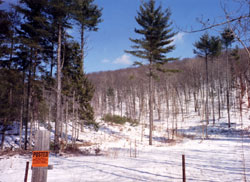 minimal due to the near clear cut nature of the harvest and the landing was next to a good Town road were probably another plus.
I have included a February 2004 photo of this (MU #5) area to show the extent of the harvest and get a perspective of those large seed producing White Pine trees that were left standing.
I hope this "landowners perspective" has helped you better understand FMPs and the subsequent implementation of recommended practices by the landowner. I will add additional updates as time goes on if anyone shows an interest.
Dennis Hodgin
West Stafford, CT

All rights reserved. ©2019 Chimalis LLC
If you have comments about this website, including broken links,
please contact the webmaster